The last talk I saw that I'll report was Bernhard's, on Algorithmic Proximity. Bernhard started off with background on the work he and Mirko have done that led up to the hybrid foam model, but his main question in this talk was to look at lower level sociality, such as in sites like Flickr, where most interactions are singular, and connections are fleeting. He is trying to understand "socio-genesis" or the process through which these low level communications crystallize into a real relationship.
In reality, individuals stand at varying social distances, or in network theory terms, where individuals are linked by paths of varying lengths which represent the probability of association. Add to this the notion of homophily; that we tend to associate with those like ourselves. (on the twitter channel for IR9 a number of people agreed that while it was true, we hated to admit it because it seemed narrow-minded).
Next, it is possible to render social interactions digitally and what will that reveal? Skipping the math... we see the importance of space somewhat reduced, and status homophily seems to be replaced by value homophily, where interest factors become more important than socio-economic factors.
Algorithmic proximity is a form of social proximity produced by the rendering of many factors in order to make recommendations about friends or matches. For example, on Facebook, the number of friends you have in common with someone may lead to a friend recommendation in "people you might know." This is most noticeable on dating sites which aim to match people based on similarity across a range of categories, and in fact is almost essential if one is to effectively filter through all the possible matches. Bernhard went through a few other examples; Last.fm, Flickr, and Delicious, and said a bit about how on these sites, similar tagging practices might lead people to start following other users.
But what about serendipity? Is homophily a feature or a bug? If we only see people who are like us, then what? I think that's a frightening prospect myself; I can think of a lot of interesting ideas and people I would hate to have missed, but if all my encounters were based on some kind of homophily, we would never have met. A fun counter example, the Unsuggester. This site tells you what books you would hate based on books you like (and maybe by extension, the people). I'm afraid I do judge people by what they read, sometimes....
I really need to get the whole paper because I think the math would be interesting, and also, Bernhard makes very strong but closely argued points, and a lot of the details have to be left out of such a short talk. So I've emailed Bernhard and if I can get more details, I'll update this entry later because this seems important to me, thought it's a tangent to Bernhard's work.
If I am to figure out how people connect and stay connected, I think this could be a really important piece of the puzzle, and also suggests measurable data I could look at in order to see patterns -- for example, what kind of proximity, exactly, seems most important? Are there certan values or other shared chracteristics that correlate more strongly with connection than others?
A really thought-provoking talk.
Wednesday, November 5, 2008
Bernhard Rieder and Algorithmic Proximity at IR9


Friday, October 10, 2008
Papers for IR 9.0
Here is our panel, by the way:
Web 2.0 sites are praised for promoting sharing and collaboration; at the same time, they are criticized for violating user privacy and profiting from the free labor of users. This panel considers the complexity of relationships among users, and between users and system designers. In particular, each paper explores what motivates user behavior, whether website loyalty, desire for sociality, indoctrination in networked behavior, or the power relations among owners/designers, consumers, and prosumers.
Elfi Ettinger presents in-depth interview results from users of an e-recruiting platform and interviews with system designers of the same platform, conducted in order to determine which design would insure long-term participation of its users.
Anders Fagerjord relates a study of what Norwegian Facebook users publish about themselves in their profiles and the way they represent themselves through "prescripts" provided by popular applications and publishing tools.
Christian Ulrik Andersen analyzes the Facebook software interface, in particular the Vampires game, to explore its discursive and semantic properties and reveal the political aspects of the software.
Kim De Vries combines a rhetorical analysis with an auto-ethnographic study of academic and scholarly Facebook users to explore how we interpret the social connections made through social networking applications.
Mirko Tobias Schaefer explores user participation that in the last 10 years has developed on a global scale and now contributes to the development of software as well as changing, commenting, creating and distributing media content.
A collection of all the papers is posted on the IR 9.0 conference site, but only members can see it and some papers are slightly abridged, besides it being one giant file. You can see full, individual papers here:
Participation Inside? User activities between design and appropriation. by Mirko Tobias Schäfer
Networking Vampires -- Life in a social network seen through a game. by Christian Ulrik Andersen
Anders is missing ”is”: Posting and Prescripts on Facebook. by Anders Fagerjord
Sustainable e-Recruiting Portals: how can we motivate career-long applicant participation? by Elfi Ettinger
And I will add mine later today... Ok, I didn't, but it's finished and out for feedback, so probably by tomorrow night... damn, good feedback means revision...
Ok, here is mine though I am probably going to revise further; at least I feel this draft is not too embarrassing. Your Friend has just tackled you. Bite, lick, or tackle them back, or click here to theorize about what this all means.
Wednesday, July 2, 2008
Bath Toy for Worm

There are so many ways that social networks impact these scenes!
Tuesday, July 1, 2008
Live from IFIP WG 9.5
Can't write too much at the moment because I will be speaking myself in 27 minutes. :-)
Some quite interesting talks here, but I am surprised (pleasantly) how broadly representative the panelists are. The conference is small--only one track of three speakers per panel for a total of 8 speakers including me! --Not counting discussants and the conference organizer, but still quite small. It leads to very interesting discussions between talks and I expect dinner will be quite nice that way as well. At least I hope so!
Some themes are emerging, but I'll wait until I have a chance to digest the ideas a bit more and read the proceedings before I comment on that. I did not get my revisions done in time to be included, but now both the slides and paper or online at Scribd. I was especially interested in David Kreps' talk and hopefully will find his stuff in the reader.
One trend though, to whet your appetites--agreement that the virtual/real or online/offline dichotomies are unsatisfactory ways to undersatnd any of this stuff. Finally!
Sunday, June 1, 2008
New Media with Dutch Characteristics. Or Female. Or?
Right now I'm reading a book for which I will be writing a review any day now... Anyway, it's called Cyberfeminism in Northern Lights, anthology that looks at how women use computer technology and ICTs in Scandinavian countries. The editors, Jenny Sunden (no website I could find?!) and Malin Sveningsson Elm argue that most books on ICTs, new media, etc, have been American/Anglo-centric in presenting the experiences and practices of users in the US and UK as universal, rather than framing those experiences and practices in a national context.
I absolutely agree with this, and in fact this belief is a reason for my own decision to focus on just one country for my own projects. And, now that this book has been published, I can now just refer to the very convincing argument they make about the need for research that considers national context, rather than assuming what is true in one Western country will be true in others. Thank you Drs. Sunden and Sveningsson Elm for so effectively constructing a step in the rhetorical ladder! :-)
Thursday, May 29, 2008
Talk at University of Twente
Now it's official; I will give a talk at University of Twente on June 25th. Here's the blurb:
A preliminary report on how scholars perceive their social network/audience on Facebook, and what effect the risk of and real border-crossing or transgressive behavior has for them personally and professionally with their colleagues. --So in other words shifting the focus the what students are doing or how they perceive us to what we scholars are doing and how we perceive each other. I make a rhetorical analysis of gestures that are exchanged between users, and in particular discuss how these gestures may help create a feeling of presence.
My own experience suggests that while perhaps there is some risk to the behavior encouraged by Facebook, there is also considerable personal and professional benefit to engaging in the prescribed playful actions of Facebook applications. They seem to encourage connections that are emotionally more intimate and stronger, which offers both personal and professional advantages. People with whom we have multi-valent relationships online may also become people with whom we might collaborate on research, or organize conference panels, or at least go to for advice when visiting their home countries/cities.
Thus I ultimately argue that along with the playful air pervading Facebook, there can also be a feeling of risk, and that users sharing experiences that give rise to this tension actually strengthen their social and professional bonds. In academic circles there aren't many venues where play and risk are valued or even possible, which may explain why Facebook has been so attractive to many of us who by rights (as trained critical thinkers) ought to be the most resistant to its charms.
So basically people get a sneak preview of the talk I will give the following week in Germany at IFIP WG 9.5 and preliminary thoughts on the paper I'm preparing for IR 9.0
Friday, May 23, 2008
Long Distance
I can remember back in 1999 or so I was first making friends online, and at the time people around me expressed surprise that I would really count any of these online acquaintances as friends. And of course not all them were or became friends, but some did. Now, almost 10 years later I am still friends with some of them, even close friends. Along the way people really stopped asking if net friends were real friends, and I have many many friends now whom I mostly connect with online--scholars lead an itinerant life, or at least I do.
But of course it's not exactly the same.
There are people I see almost every day or every week in my immediate locale whom I consider friends, a few of them close friends. But even those that are not so intimate emotionally I know quite well in other ways just because I see them often. So I know what they typically eat, or whether they prefer coffee or tea, what kinds of clothes they like to wear, whether they are morning people or night owls--and this is all without explicit discussion. I just observe it.
I know these things about some of my online friends too, but only if we talk about it. I don't know about others, but when I am taking time to email, or IM, or chat, I don't usually spend time on these little details unless for some reason they become important as part of a larger point. But even as I write this I experience the same problem of what I would describe vs what might be observed--there are some people, a few, with whom I am in such close contact that even though we are only connected via skype or email, these details come through. But when describing our daily lives through an online medium, we all make choices about what to leave in or out. These choices create some picture of us for readers that really is only a thin slice of our lives, so in some ways our online friends almost inevitably have a distorted picture.
This is not to say people we see in person don't have pictures of us that are distorted in other ways, but I think the distortions may be less exaggerated because a broader range of information is available. Online we have mainly text, maybe some pictures or videos, and almost all of that is chosen by the author (leaving aside for now the issue of involuntary publishing that afflicts people with highly public identities). So it seems to me that this may serve to concentrate the distortions.
But does this actually matter? I don't know. As I said, some of my online friendships started 10 years ago and those that have lasted always lead to meeting in person at least occasionally. So maybe this is really no different from the largely epistolary relationships that were common before the telephone, or before rapid travel became fairly accessible to large numbers of people. But having both kinds of friendships does sometimes make me feel in an uncomfortable way that there is some kind of disjunction between those with whom I feel closest and those whom I might guess have the widest range of information. Are those closest friends closest to the "me" that I think of as "me"? I suppose the question has always been there, but now technology makes me really notice it often. Damn computers and ICTs. ;-)
Wednesday, April 23, 2008
Open source women back each other up program
The Open source women back each other up program is not really a techy program, but rather:
1. a program I completely and utterly support because in the US at least it is really needed.
2. an interesting example of how the meaning of a techy concept, open source, is being contested. Or rather, how it's metaphorical meaning is being contested. And I agree with one person who comments on the whole thing, the guy who came up with the "open source boobs" phrase should have been saying public domain. Jackass.
--And this is what started the whole tempest to begin with.
And while I will say like everyone else, this response of course is parody; I find it really really tempting sometimes.
The science fiction community--more fun than a barrel of weasels. Or ferrets. yeah.
Sunday, April 20, 2008
More about Facebook
Since I am speaking at two different conferences about the way people participate in Facebook, I have been (believe it or not) reading about Facebook, about relationships online, about what motivates participation, and so on.
here are a few things I've noticed:
- Though it was noted at least 5 months ago that many faculty are now using social networks and that 25-34 year-olds is the fastest growing segment of users, no one seems to be looking at how or why they use FB. Some articles have been written about faculty disclosing too much online, but so far I have found nothing else.
- Almost every academic study (and there are many) concentrates on either how kids/teens use FB, class, racial or ethnic differences in who uses FB, how to use FB to teach, or how to use it to make money.
- There are lots of non-academic slideshows and articles comparing FB and MySpace about how to make money or seduce women with FB. --I mention this because my search efforts are hampered by these kinds of documents cluttering the web.
In offline societies, it is generally possible to tell whether a person is present or not. Presence and status are acknowledged by others making, at the least, eye contact or grunts in a person’s direction, or by their pointedly ignoring that person. Identity is reinforced by reaction. People are generally aware of who is listening to the conversation and of their reactions to each other. Online this is usually not the case. It is possible for a person to be present without others being aware of them: there is no marker of existence beyond the act of communication itself. “Asence” is the term I have coined to express this almost ontological uncertainty, or suspension of being between presence and absence.Marshall goes on to argue that in an effort to overcome asence, participants will exaggerate gender characteristics and may also use romance and even netsex to reinforce intimacy. He developed these ideas from studying the Cybermind mailing list, but I think asence could explain certain behaviors I've noticed on Facebook. --more details on that soon.
Two other useful possibilities involved Fluxus and the theory that humans have evolved to be 'infovores' --love that term! But I'll save those for the next entries...
And by the way, apparently Twitter addicts are 61.3% more likely to visit Barcamp.org than the average internet user. --Not directly related to anything, but it caught my eye. ;-)
Saturday, March 29, 2008
Where the hell are my slides?

I look so serious because I have had my laptop for only a couple of days and I can't remember where the hell I put the presentation slides. :P Lucky you; they can now be found here. [Thanks to Scribd, which is the easiest site I've seen for sharing files of all kinds--not like GoogleDocs for editing, just for sharing, plus with some social network and archiving kind of stuff built in. It seems cool.]
It was a good panel though and felt more coherent than many of the other internet/web/new media panels. And we had discussion that ran over the break and into the next panel which was rude of us, but also signals a good panel. ;-)
Sunday, November 18, 2007
Embodied experience and the post-conference buzz
I'm not sure if it's true for everyone, but I notice that starting by the end of my first day at a conference and lasting for weeks after, I often have so much more energy for writing than usual, even though I've keeping long hours and maybe having drinks as well. So what accounts for that?
On one of the now numerous email lists of which I'm member, someone posted about how interacting face to face always creates some energy that flows around between people. I'm not sure if that's always true; sometimes socializing can be a bit of a strain, if for some reason it feels awkward. But on the whole, I think that's right. Whenever I go to conferences and meet even one person I really connect with, I'm energized. Once I've made these connections, I can usually solidify and sustain them through a combination of email and skype, facebook messaging (and playing) and so on. I even find these virtual contacts energizing, if I have real conversations. And lately I've experienced something of that energy even with people I've never met in person, but in those cases I also feel an even more urgent wish to meet in person.
But I think there is something about physical presence that so far can't be replicated or replaced by any virtual modes of contact. In a way it's like falling for someone in that there's a a similar feeling of immediate connection, of excitement, except it's over a different kind of prospect; an intellectual potential, rather than romantic. --Or maybe romantic too, for some people. ;-) Or maybe only I feel this way. Most academics would hesitate to admit this, even if they felt it, I think, because though even porn is starting to be accepted as a subject for study, it's still not really ok to talk about being motivated in our own work by pleasure, other than the most intellectual and abstract. I think that so many academics are suddenly not only joining Facebook but also getting really involved in it is that it allows expression of some of that same kind of pleasure that we experience when meeting in person.
Monday, October 29, 2007
"Appropriate " use of Facebook and similar sites
In a recent talk, Danah Boyd said that she doesn't use these social networking sites the way teenagers do, nor should she. Now the first point is inarguable, but the second struck me as rather odd. I don't see that there is any "should" about it. I mean, call me immature, but while yes, I am studying Facebook and will write about that, I'm also having quite a lot of fun with it.
I spend time sending my friends "drinks," "throwing sheep" at them, plus messaging, sending links, videos, etc. Not to mention playing that goofy vampire/zombie/werewolf/slayer game. In fact, if it weren't for my enjoyment of this new channel for social play, I don't think I'd bother with it at all, though a number of professional and activist groups now have a presence there. That would feel too much like work, and I work all the time anyway.
I'm also trying to explore Second Life, but I find that I'm not very interested in exploring because while the world itself is interesting, since no one I know is there, I'd rather spend my time in virtual locales where I can talk to my friends. Does that make me immature? Is that an inappropriate attitude for a scholar? Well, I don't think so and given who else is on Facebook and using just as playfully as I, I'm pretty confident in my position.
We'll see what happens when I stand up and say this in front of a bunch of other scholars at SLSA this week...
Saturday, September 22, 2007
Why do we all love Facebook?
I've really been wondering about this; all of these friends and I are supposed to have seriously critical attitudes toward Web 2.0 and all that, but were acting just as goofy about Facebook as our own undergrads. This really got me thinking about what is so powerfully attractive that in spite of knowing about the privacy issues, the labor issues (providing content for free, right here...) and all that stuff.
Right from the start I noticed how much the interactions encourages by Facebook remiind me of how my college and/or grad school friends and I used to interact. We saw each other everyday, ate together often, left each other notes, phone messages, were in class together, went to parties together, and spent hours and hours talking about, well, everything. We did know each others favorite movies, music, books, food, color, clothing style. And we knew the "whys" behind every preference.
Now, I've come to realize that I am one of those very social people who will use any channel available. But I wonder how much everyone who has experienced the the kind intense friendships I did in college wishes to regain that kind of connection. During grad school I realized that everyone was getting busier and busier and it was proportionally harder to maintain the intense connections we had enjoyed before we all started to become really "professional."
I'll post some more about this later, after I observe some more... ;-)
Wednesday, September 19, 2007
Facebook Mania
I've had an account on Facebook for awhile and thought it was rather boring, but suddenly some of my friends are joining--all people who study new media things.
The funny thing is that now that were all on there, we are acting just as silly as the obsessive college students about which all the news-stories report. So we send each other virtual high-fives, little "gifts" --just icons-- we post things on each other's profiles. And this is in addition to all the emails, skype calls and chats, etc. etc. Of course this has only been goiing for about a day; maybe we'll all get bored and drop it.
But, and I don't how long these have been available, there are quite few fun applications you can add into your profile, so that's kind of fun too... now if I could just connect it to my SL avatar, I could close the circuit completely.
Thursday, August 2, 2007
Cultural groups and academics take over social networking sites
OK, not really, but Theory.org.uk has a Facebook account now, MySpace has a group called "multimedia electronic literature and art: the subversive and avant-garde" and a number of the edgier arts and academic groups have MySpaces, such as Worm, in R'dam, and the C'Lick Me festival has a MySpace. And of course many people are on Linkdn--me, Henry Jenkins, several folks from De Waag Society. Of course some people have the "excuse" that they are researching social networking sites, so they have to register, but I do find it creepily addictive, or would if it were my only way of connecting to people.
Yes, the debate has run for years and years about whether socializing online isolates you or the reverse, and I'm not going to get into it here (which means I'm going to get into it some, but not a lot). I think that most of the time, the extent to which people socialize online reflects the the extent to which they socialize generally, with some specific exceptions, such as GLBT people who have no local community, or members of an ethnic diaspora, or something like that. (and in fact, a Pew study on internet use finds this as well). Ok, I have to find the link to that study...meanwhile, according to the latest Pew quiz, I am an "omnivore" when it comes to ICT. That means that along with 8% of Americans (who unlike me are in their 20s!) I use ICT "voraciously" for all kinds of things, including socializing.
And I do fit the pattern they report; I am usually very sociable in person as well--as any of my colleagues will attest having wasted enjoyed chatting with me at length while I (at least) am escaping some actual work. On the other hand, I'm not so fond of mobile devices, or rather, of what some people assume my having them means--that I will always be available. But some people even assume that about email. --Just say "no" to instant responses.
Anyway, what I've noticed is that when I have many avenues available for socializing, I don't care so much about doing it a lot on line--face to face is always nicer, when possible. During those times I just email or chat with people I just can't see because they are too far off--and even then we send pictures back and for or maybe skype also.
But, when I get so busy that I can't actually meet up with people, or when everyone is away, or whatever, then I find I am far more focused on email and other online contact, and even get quite agitated if I try contacting a bunch of people and no one answers. And then of course I feel like an idiot, because what am I, 12? Do I seriously think someone is shunning me? No, so why worry? Which leads to the next question; after how many days is it reasonable to worry that a) someone is ignoring you on purpose, or b) he or she has met with some misfortune? And is it different between friends as compared to professional connections? --Of course these questions are hardly unique to the ICT age; "waiting for a call" is a widely recognized scenario; Neil Gaiman recently published a really funny poem about it, and it could just as easily be about waiting for email, or IM, or text-messaging.
So I was originally talking about academics and social networking, and my point is, that while some might say they just do it for research, I think most of us end up rather enamoured of the whole business. It's rather flattering to see that some people link to my Del.icio.us page--it affirms that my sifting through the sea of information is yielding at list some value. And knowing that people are linking to that actually makes me feel a certain sense of responsibility; I know how disappointed I've been when I find that a really useful site is no longer being updated. Maybe it's not creepy (maybe that's only me ;-) but it's certainly interesting. Or maybe that's also only me...
And does this mean teens all over the US (at least) are going to become all saavy about critical theory and computers too? You are now entering the twilight zone...
Saturday, July 28, 2007
Scholars and Artists
In the last couple of months I have enjoyed meeting a host of really interesting scholars and artists. I've written about those I was seeing or meeting in an official way--keynote speakers, panelists, interviewees, etc. But, I also met quite a few people in a more casual way who are also doing research and or art that ought to be getting some attention. Plus they were just cool and I enjoyed meeting them so much!
So, who did I meet...
Well, I guess it's easiest to go chronologically. At New Network Theory I met Matthew Fuller briefly; he was Course Director at Piet Zwart before Florian, and I had the fun of listening as they argued over the rough draft of Florian's talk. We didn't actually get to talk much, but I have just been informed by our library that his Media Ecologies book has come in, so I will probably write him about it later. And post more here, of course. Then I met Olia Lialina, whose talk on html style I enjoyed a lot. I don't think I posted about that yet--maybe by next summer I will have caught up. Anyway, she was nice, but I was so jet-lagged, I doubt I said anything remotely intelligent or memorable. Maybe next time. I spent a little more time with Jacob Lillemose when he and I and Florian had dinner on the first day. He's on the board of a Danish group called ArtNode, an independent Research Center for Digital Art and Culture. I should interview him! But when we met we talked more about his dissertation which if I recall aright, is about "Post-object Aesthetics." One thing I found really interesting about several of the people I met is that they already have a lot of authority in the field, have publish, are giving keynotes, directing things, all before they have even finished their doctoral work. Very impressive. We all shared Rijstaffel and it was delicious.
The next day I met few interesting people very briefly, but then met two again later at length. My panel was chaired by Ramesh Srinivasan who is in his own words an
Assistant Professor of Information Studies - University of California at Los Angeles (UCLA), holds a M.S. Degree from MIT's Media Laboratory and a Doctorate degree from Harvard, and has focused his research globally on the development of information systems within the context of culturally-differentiated communities. He has studied how an information system can be developed to engage communities to develop their socioeconomic, educational, and cultural infrastructures. This has included an analysis of how the cultural practices specific to communities can manifest themselves into an information system's architecture, particularly with respect to how it represents, categorizes, and disseminates the information it stores. This research allows one to uncover mechanisms by which local visions and practices can converge with international development initiatives. His research has spanned such bounds as Native Americans, Somali refugees, Indian villages, Aboriginal Australia, and Maori New Zealand.
We spoke briefly afterwards and agreed we should stay in touch. I need to email him now that I'm home because I think the kind of work he's done would be really relevant to our students and community.
One of the most interesting panels I attended was the one actually titled "Network Theory" --why they got that title out of everyone, no one seems to know-- and I thought the most interesting speaker was Mirko Tobias Schäfer who was proposing a new metaphor, foam, for discussing social relationships. In this case online, but actually there's no reason to restrict it to that. Anyway, I spoke to Mirko a bit after the panel, but we were both rushing because everything was behind schedule and we almost missed lunch and the next session (which I was speaking in). Happily, we both were at the Piet Zwart graduation show where we were able to chat much more comfortably over beer and art.
Mirko has written numerous papers about opensource culture and communities, many of which are available at his website; about half and half English and German. (of course, not the one on Foam...) Right now he's writing his dissertation on "Bastard Culture! Competent Users, Networks and Cultural Industries". More to the point, he's a nice guy who has offered to let me grill him about his work via email and skype. And, he's another who seems to have accomplished a lot even while finishing his PhD. Coincidentally (or I suppose not, given our shared academic interests) Mirko is doing his doctorate at the University of Utrecht where he sees a fair amount of William Uricchio, whom I knew at MIT, and UU is where my other conference was.
Anyway, he's written quite a bit lately about how users of both software and hardware contribute to it's development through hacking, and how people actually learn to do this--that is, how naive users gain enough knowledge to even join communities in which they can learn more. Figuring out this second part will be crucial to the success of our new programs because our students may be as inexperienced a group of users as you can find inside a developed nation, so I'm glad to have found some people who are studying this, and who are so cool! It's lovely to have so many nice and grown-up conversations in such a short time--in fact, after 4 years during which the majority of my talk was with someone under the age of 4, such intellectually stimulating discourse feels almost an illicit pleasure. And I want to especially thank Mirko for our long talk at the graduation show; all the other people I already knew from Piet Zwart were obviously busy, so I might have felt a complete wallflower. (Not to mention that professionally interesting talk with charming people is the thing I enjoy most during conference trips, so I'm indebted to anyone who contributes.)
He also offered to sightsee with me, which would have been fun, but we both ended up being too busy to coordinate very well. (In fact, given that I was visiting for 16 days, I didn't do so much sightseeing.) --Several people I met offered to let me stay with them if I wanted to visit their city during my trip, and I only wish I could have had more time to do that, and know these people better.
Finally, I also got to speak a few times with Kristina Andersen, who this year has been a tutor at Piet Zwart and who is an active artist connected to Steim. We had and interesting talk about being working moms, and gossiped a bit about other people in the field. She gave a very interesting talk a few years back about how artistic collaborations work (or don't) and hopefully we'll talk more about that some time. She's another PZI teacher who clearly has meant a lot to the students and who cares about them too.
I think that covers the first conference and the PZI events. Next time some people I met at Remediating Literature.
Friday, July 20, 2007
Evolution of Worm
Now I will also finally finish writing about my meeting with Hajo, which I only half-covered before it was time for me to leave the Netherlands, and I'm anxious to get it all down. --I'm sure at least a few other people will write about the conferences I attended, but I'm the only one who spoke with Hajo and it was such a great conversation that I think it would would be much worse to leave that undone. Plus I enjoyed the conversation so much that I really want to get back to it--in fact I've sort of been saving it as a treat for myself. The more I think about it, I think I have a crush on Worm. --I realize that sounds perfectly stupid, to have a crush on an organization, but I was so impressed with it that I find my self wanting to prattle on in the most ridiculous way. Apologies in advance if my prose becomes tiresomely gushy.
In the first half I wrote a lot about how people-centered Worm (and Hajo) seemed to be, but he also describes himself as a Darwinist, saying that the situation for cultural institutions in Rotterdam and in the Netherlands generally is a war and that this is good; "it keeps a alert but it's not personal." Hajo also feels that the competition helps the whole scene to expand and attract attention. Of course people often say that things aren't personal when in fact they are, but in this case I was convinced that at least Hajo really felt it wasn't personal, because when I asked if there was anything we had discussed that should not be published, he said no, it was all ok. --I know, maybe our whole conversation sounds pretty tame, but he did make some comments about the other groups that might not perceived as very, ummm, flattering. But Hajo claims that he likes his counterparts at other institutions in spite disagreeing with their approaches and attitudes, and at the same time recognizes that he and Worm are not immune from those same criticisms. As he said, "those guys at V2, they are so smaakie; we are smaakie too, but we know it....ten years from now someone might be saying 'those guys from Worm...' but that's ok." --I haven't yet been able to find out exactly what smaakie means, but you get the picture.
In fact Hajo is trying to seed the next crop of contributors to the Rotterdam cultural scene by getting involved with the Media Design MA students from Piet Zwart, but it started pretty casually. As Hajo put it, they were working with Piet Zwart because of people. First of all because he and Florian [Cramer] had met, hit it off and decided they would like to work together. I've come to realize that many many collaborations start this way in both the academy and the art world, and I suppose it's no surprise. To succeed, people have to work very closely toward shared goals, so I think it's natural and helpful to work with people you like and with whom you share at least some ideas. Anyway, Hajo and Florian started talking and this is the first project. For Hajo it brings new blood into Worm; some of the students may decide to work or perform here later. Hajo is also always looking for new ideas, to see something new that they can combine with something old in public programs to inspire people. Hajo is always asking "what can we learn from past innovations to inspire new ones?"
To the right you see Audrey Samson's graduation project, 'spectres'? as it was installed at Worm, 7/7/07.
He goes on to say that "I want to contribute as much as we can...making it [new technology] into a social context, interesting, being an ambassador, making it[computers] into a normal field."
Hopefully in a few years the students can contribute something back to the field. This is a long term investment for Hajo because he believes you have to be a little older to be radical. At first this sounds counter-intuitive because young people are often assumed to be radical by nature, but I think he's right. It takes experience to know where the boundaries are and what would be a real innovation.
At this point in the interview, Marco, who does all the accounting, walked by and commented jokingly that the people at Worm are technocratic conservatives, but with love. Hajo laughed and agreed; they try to leave good things in place and alter the bad things. They don't follow trends just for the sake of them, so they are multidisciplinary not as a goal, but as a practice. Their experiments have taught them that a party can be a medium; so can a meeting. So they will use whatever media best let them explore a possibility and bring it to people--in this way they are "radically pragmatic." This holistic approach means that rather than regarding meetings as a necessary evil or parties as merely celebration after the fact, both are an integral of the discovery process.
This sounds like a productive way of working, but also perhaps more challenging. I asked Hajo what the biggest challenge was, especially when collaborating with another institution. After some thought, he replied that "dealing with really talented people means making a structure in which they can operate." In this instance of collaboration with Piet Zwart, some of the people working at Worm stayed up all night once or twice to help students who (proving that there at least some universals) needed to do a lot of work at the last minute. Hajo asked them how they felt about that, if it had been fun to work in that intensive way and apparently it had been.
Here Florian talks a member of Worm in the the Wormshop about possibilities for future collaboration. I was impressed by how open everything was; they all just did their business as usual, even though I was just hanging around snapping pictures, a stranger to everyone except Florian.
Worm is not a rich organization; they started as an artists' squat and now depend mainly on grants from foundations and the government to support more ambitious projects, so they have to think about their spending priorities. This is another way they work on providing a structure--"so the office is crap, but the performances are good. Eventually they will get fed up with the office and fix it." Again, it depends on what the people working at and with Worm most need.
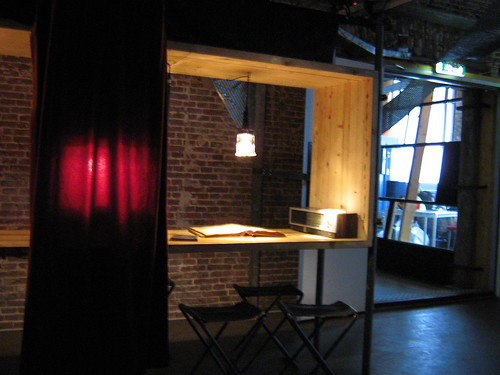
The group has worked in several locations before moving to their current space in an historic building in Delfshaven that presented quite a challenge. Because it is protected as a historic monument, Worm could not make any structural changes except those required by fire codes, so they took a novel approach to constructing their space. Working with architects who followed the principle of "superuse," they constructed a new interior structure entirely from salvaged material, and all either free-standing or attached only to a metal frame made with clamps braced between the walls, floors and ceilings. This frame is held in place only by pressure, it is not fastened to the building's structure. (For more on the construction, read about it in the Superuse book, or visit the 2012 Architects' Worm set on Flickr.)
Hajo likes the space but is not especially attached to it and had thought that it would be fine if they had to move when the city finally decided what to do with the building. But, he discovered during the weekend of the graduation show that some of his colleagues had come to really care about the building, and didn't want to juts give it up. So now Hajo is working on a proposal to buy the building, because he wants the people he works with to stay and be happy, and to do that, they need to have a more permanent home.
Given his other beliefs, it's not surprising that Hajo prefers a DIY approach, but he also has pragmatic reasons as well. Superuse is not only environmentally sound, but is significantly cheaper, just as switching to Linux allowed Worm to operate with a collection of salvaged computers without having compatibility issues. But this also allows them to be "masters of new technology rather than slaves."
At the same time, Worm no longer works outside the system. When talking about the difficulty more radical groups have with a transition to working with the system as they become more established, Hajo exclaimed "don't complain about the system if you aren't taking part in the system." Worm maintains a balance between a DIY approach and being a regular institution. "If freedom is 0-->100, we are 85, and this is a success. That freedom allows them to present acts, artists, films, or speakers that might only attract a few people, and count them as successes if they are interesting, rather than measuring success only by numbers in the audience or money in the till. Measuring success also takes time; Worm started the practice of "Live Cinema" which is occurs in venues all over the world. In that way it was a great success, but no one remembers that it started at Worm. But in Hajo's words, "if you really do something, you make a difference and that makes it fun."
Monday, July 9, 2007
The heart of the Worm
Having caught up everything about the graduation show, now I'll get to the meeting I had this morning, with Hajo Doorn, director of Worm. I'll start by saying that of all the meetings and conversations I've had about how different institutions work here in the Netherlands, this was by far the best. In addition to offering me a wealth of information, Hajo let me really see inside Worm, as if I wasn't some random person dropping by, but somehow part of things. I'll explain that a little better later, but let me go in order.
Worm really is unique--of course every place wants to think that, but usually it's not true. In this case though, I can't think of any other cultural or arts organization I've ever seen that runs exactly like Worm. First of all, the range of activities is amazingly broad. Events held there include dance parties, film screenings, live bands, sound art installations, electronic/computer art installations, lectures, and educational activities like the recent Piet Zwart graduation. Worm also stands out because of the way they balance their growing role in the community, which gives them more chance at funding and at shaping the local conversation about art and culture in Rotterdam, with still maintaining the freedom of an outsider to take risks and to do things a little differently. That last is no small feat when dealing with civil servants and funding agencies. Finally, Worm is focused on people, inside the organization and those they collaborate with or invite in, rather than on their own institutional status.
This last characteristic was what Hajo most emphasized. But before I expand that point let me back up a bit and first say something about Hajos' take on the whole scene. The Netherlands is a small country, so it's not so hard for a group to get started and get some attention. They all compete with each other, which Hajo thinks is productive because it draws more attention to the scene as a whole. But, established institutions try to claim the discourse, which shuts out groups; this means they have to work hard to find a niche and show how they are different. Taking V2 as a contrast for example, according to Hajo, "V2 is big in their scene, but it's very small scene." He also commented on how they were not very connected to the local community, or to the open source community. I had noticed the latter when talking to Alex and everyone seems to recognized the V2 is very narrowly focused, the only question is whether they think the narrow focus is a deliberate strategy, or something that dooms V2 to shrinking relevance. Other organizations also seem far more hierarchical; both V2 and de Waag have a clear and seemingly rigid hierarchy with the people on top exerting very firm control over everyone else and having set guidelines for how they do everything. I'd say de Waag is not as rigid as V2, and maybe they need more structure since they have so many community stakeholders.
But Hajo and the others at Worm take it as a principle that they "design for people, not for systems," which means they have often asked their funding organizations or the civil servants they work with if they really want this kind of report or that kind of procedure, because it will cost so many thousands of Euros to produce. Often, the answer is no, and they find a different way to provide what the funding agency or civil servants need. In fact, while the other organizations I visited explained their goals and criteria, which were all about art, culture, and sometimes the community, I didn't get as clear a statement from them on their operating principles. Worm has several worth listing here:
- Energy is the most important quality [of a work or project]
- It's all about people
- Let's not pollute
- Design for people, not for systems
- Challenge the system
- Try to pay people, even a little
In fact, Hajo wasn't too concerned about this. He thinks that art should be local, and also he's really into a do-it-yourself (DIY) approach, which doesn't require huge chunks of money and isn't really consistent with international ambitions. Because he's always trying to do a lot with a little, Worm uses Linux running on computers that were salvaged, and Worms physical space is made with 80% recycled materials, mostly industrial salvage from the port (of Rotterdam). Along with the Polder model, the Rotterdam context is also very "flat" compared to other cities in the Netherlands, meaning that it's pretty easy to get access to officials, which helps groups to get started.
Hajo shared a lot of other information--it was a three-hour meeting, including coffee and the chance to listen in as he talked over the success of the Piet Zwart graduation show with Florian (who was there with students making official documentation) and as he talked about possible future collaborations, plans for the building, how to spend out the remaining budget--I've never seen another group be so casual, except maybe my own department--maybe that's why it was so comfortable. Anyway, I'll post more tomorrow because it's getting late!
Friday, June 29, 2007
NNT, Day 2
Here I am again and this time I've snagged a seat near one of the few electrical outlets in this lecture hall. I'll try to catch up some of my earlier notes before the morning plenary starts--we're already 15 minutes late though...
Yesterday I also saw Tiziania Terranova and she had interesting things to say about immaterial labor, capturing customers and harnessing collective intelligence. She compared Yochai Benkler's ideas with Maurizio Lazzarato and Gabriel Tarde. Mainly she was arguing that social networks and even more online communities are about relationships, not economics, even though they have real economic consequences. One of many instances when it was unclear whether a speaker really meant to talk about networks or communities--this is a problem in my paper as well. Also some trouble just with the microphones hampered her talk, which was too bad, because I think she was getting at an important idea.
Next was Wendy Chun talking about imagined networks. This was the best of the first three presentations. She started with some questions: what needs to happen so that we think of interactions as networked; how do social and technical abstractions coincide, interact, etc; and a third question I missed because my jet-lag made me fuzz out for a minute... Maybe it was the most basic: are networks communities?
An important point to note before she gets started: public/private has shifted to all private that are open/closed. Her primary example (which unfortunately is not so well known in Europe) was Facebook which she argued is a profoundly nostalgic in its drive to create a feeling of intimacy. And, people join networks when they feel excluded. --probably true, but I think almost everyone feels that to some degree, or in some arenas, so is it a useful distinction? She went on to describe Facebook and how it works and eventually got to the idea that these networks are enduring though ephemeral. But, they aren't memory, they are just data storage. Memory requires "diligent regeneration." I'm sorry to say that by this point I was really getting unfocused, so I hope her paper will be available online--it seems that hardly anyone turned one in on time for the proceedings CD.
Thursday, June 28, 2007
Back to live blogging
OK, I charged the battery a bit, so now back to live reporting on the first day, just in time for the very last talk by Florian Cramer. I'll go back and post my notes from the others later. A nice intro by Matthew Fuller who mentions that among other things, Florian has won in a new category for Prix Ars Electronica for best contribution to media theory. He seems embarrassed by it being mentioned. Unlike most of the other speakers, Florian is (as usual) eschewing slick presentation styles and just giving us white on black screens that look like (and in fact I think are) what you get in a terminal window.
I had the chance to see Florian's original presentation notes and of course he's not following them, which means now I have trouble identifying what I really need to note down. So what is he saying...he starts with talk of an "elegant paradox" between the syntactic, linear aspects of language and the paradigmatic, that is associative meanings of words. so there has always been a sort of weblike character to texts and in fact textus actually means web.
Then we are on to Barthe turning everything into a text, from beefsteaks, to striptease, to well, anything. At the same time, traditional philologists think of text as only about paper. Computer tech though has allowed us to see what really texts are or aren't. Ok, now I know where we are.
Syntax --> what is computable
Semantics --> what is computable only if turned into syntax
so text is just an amount of (in most cases alphanumeric) symbols
You can't really get this from a beefsteak or striptease.
So webs and networks have comparable limitations.
You can describe any network in a flat linear way, the complexity can be boiled down. But he is not proposing this as reduction, but as analysis. So maybe networks are not so different from anything else. (such as texts).
Just as texts were initially defined as anything, and we were in linguistic trap, now everything is networks and we seem to be falling into a technological trap. Despite the humanist agenda, since the 40s, the sciences were mapped onto culture, which leads to a variety of problems.
(big jump here, because I had to stop and really listen. Damn him for saying something interesting and dense)
With the assumption that the media is the message, media theory became sort of a rehash of cybernetics. The network is another cybernetic metaphor that conflates things should be differentiated. But cybernetics also takes these things literally, so interdisciplinary work always teeters on the edge of falling into the trap of mistaking a metaphor for a model.
Critical theory should be wary of taking these metaphors too far. Cultural studies and media studies have too often bought into techno-hype, and used technological terms too sloppily. He gives an example of how "signal-to-noise-ratio" is a concrete mathematical concept, but also is used in discussion lists, first as a metaphor, but then applied in the creation of semantic filters, which is questionable.
So remember:
Storage is not memory, feedback is not interaction, data is not knowledge, computation is not cognition.
A new network theory would have to consider the networks of metaphors spun and the conflations in a critical way even as it uses them. (that's rather provocative since he's basically implying that up to now we haven't been doing this...in fact could be read as a criitique of this conference's themes...) Oops low battery again, questions are interesting and so are Florian's answers, but I have to stop. More later.


