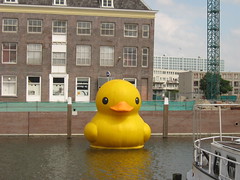
Interrupting my conference coverage to try catching up some of the other stuff I've been doing. This piece of art by Florentijn Hofman is out in front of Worm (about which I've written quite a lot already). I love the duck, but also I was interested to hear from Hajo that because Worm had some connection to the artist, they were able to have the piece anchored there for a few weeks at a much lower cost than was usually charged.
There are so many ways that social networks impact these scenes!
Showing posts with label Rotterdam. Show all posts
Showing posts with label Rotterdam. Show all posts
Wednesday, July 2, 2008


Friday, February 29, 2008
I am so behind...
Even though I'm not teaching as much this term, I am just buried in work. I'm co-chair a conference that takes place in two weeks and will so glad when it's over. What a headache. Plus I am trying to work on some grant proposals, sent in the two IR 9.0 proposals, and just sent off a chapter proposal. Whew. On the up side, if the conference and chapter proposals are accepted, I will have a lull on those fronts until summer at least.
Speaking of summer, I will be headed to the Netherlands again for more interviews. I've been doing some via email, but I also need to go on site to visit some of the new media programs/centers. I may also give some talks, but that's up in the air right now. Whatever else happens, I will see all my Rotterdam friends again, and finally (I hope) meet Brenno de Winter in person, plus a new acquaintance, Elfi Ettinger. Elfi is on one of the panels I put together and teaches at the University of Twente.
In spite of being so busy, I spent most of the day in a workshop about writing successful grants, except for the last two hours in which I heard Clark Buckner speak about "Autonomy, Plurality, and Play in Contemporary Art." It was a good talk, and the workshop was informative, but I'm just exhausted now. More later.
Sunday, January 27, 2008
More on the trip
After my talk at De Geuzen, I wandered around downtown a bit and then had dinner with Florian at a cheap but good Roti place near Piet Zwart's new location in the Kareldormanhoff. We are still trying to think about how to do a joint MA, but it's proving much tougher than I originally expected. I think we (the CSUStan group) will have to get our MA going, and maybe first try some simple exchanges for course credit. Also, the the CSU is under threat of major budget cuts, and so any new projects will be harder if we are all tightening our belts.
I was still really jet-lagged, so after dinner I went back to the flat and tried to answer email or read, or something, but while I had trouble sleeping I also couldn't think very well. So annoying. I should have drunk more at dinner. ;-)
Wednesday I had another interview scheduled with Hajo Doorn, director at Worm, and thanks to my jet-lag I woke up barely in time to dress and race over there. This time we talked less about Worm itself and more about how Hajo sees the Dutch new media scene and his own role in it. I was impressed at how ambivalent he felt. I say impressed because Worm seems to be doing very well and Hajo himself has gained some influence, including serving on some kind of committee or board that awards grant money for projects. I'm not sure how many people in this position would question what it meant, whether it was right, so I am impressed that Hajo does.
He made several striking comments in this vein. First, and this seems to be a shift since last summer, he thinks Worm is in a way forced to be too big now that they are successful and receive funding themselves. They have to employ a lot of people in order to comply with the requirement of receiving funding, and maybe its good that all these people have jobs, but a lot of money is now not spent directly on projects. Also, he's not even sure that their projects are always the most deserving or successful--that goes back to our earlier discussion of how success is measured. Also, based on his comments on certain other groups, I think Hajo worries that he will become disconnected from real innovative work, because he's so wrapped up in administrivia. Finally, he's not sure the project he is involved in evaluating are always so great, but who knows, maybe that's not so important either, maybe the experiment is worthwhile. I haven't met anyone else willing to be this forthright and I admire that like hell, because of course it's a risk, both personally and professionally.
We also talked about what kinds of work is most interesting right now, and what is overrated. Hajo is completely fed up with what passes for interactivity, and I agree with his critique. He gave the example of an art piece in which people step onto a platform with sensors that measure their feet and if their feet are one size, a light this color glows, and if they are that size, a different color light appears. So what? Unfortunately a lot of interactive pieces do seem to remain at this really basic level and so they very quickly become really boring. I further agree that for real, interesting interaction we would probably do better with artificial intelligence.
When I think about, for example, the web sites that are interesting, they are those that facilitate interaction with others--whether we speak of something like FaceBook, World of Warcraft, old-school MOOs, or what have you. And compare this to static texts like novels, paintings, movies. Though these don't change, they represent (I think) a density of the creator's/s' thoughts that readers or viewers can interact with over time. So, interactive new media, to succeed, has to either connect us to other people, or in someway recreate the experience of a conversation with another intelligence.
I'll have more on the conversation with Hajo later on, but I have to to catch up on other stuff--I am so behind on my entries!
Tuesday, January 22, 2008
Catching up a bit
So, last term got completely crazy toward the end. In addition to the stuff I usually might have to do--teach, direct the comp. program, do a little research and writing--I also have been trying to write some grant proposals, organize a conference, and chair a search committee. Oh yeah, and I had to do a job review for myself...and the computer was stolen...so yeah, totally crazy.
But, I did the job review, kept the search under control and the conference, and the grant proposals are ok, for now at least. And, I may buy a Macbook Air in a week or two... But the main thing is that I got things wrapped enough to make another trip to Rotterdam in January. The trip went really well, but I now know that 6 days on the ground is really not enough when you have 6 hour jet-lag to get over before you can function at all.
So, what did I do this time around? Well, since you ask... I spoke at De Geuzen as part of their Living Room Lecture program, about Sequential Tart and super-heroines. That was fun; there was a live audience of six people, with more online, though I think only a few were formally signed into the chat. Anyway, the video archive of the first part is online already, and also some pictures. I was pleased that I could speak comfortably in front of people who I know and whose work I respect a lot! I mean, it's one thing to address strangers, or students, but I actually care about my friends' opinions. ;-) So this was the first official event for me.
Monday, October 15, 2007
Raving about the Netherlands over at Sequential Tart
See your author re-live her adventures in Rotterdam and enthuse unashamedly about the people she met and sights she saw.
The Netherlands, From A Tart Point of View, Part 2: Rotterdam Culture Crush
This article ended up being a weird mix of your usual travel stuff with far more personal revelations than I had been planning on. Or am entirely comfortable with. But now and then it's happened that I found I was revealing quite a lot of how I felt and decided to go ahead because that reaction was a true reflection of my experience and concealing it would have felt dishonest. So there it is.
Sunday, July 29, 2007
Americans in the Netherlands
I met quite a few Americans while in the Netherlands; that by itself isn't so surprising but I was startled at how many were from Californian universities, mostly the UC. At New Network Theory, Alan Liu from UC Santa Barbara spoke, and Ramesh Srinivasan from UCLA (discussed in my last post), and Warren Sack from UC Santa Cruz--there may have been others too. Then at Remediating Literature, Katherine Hayles, also from UCLA, gave a keynote. Apparently I need to go to another country to meet fellow Californian faculty. Well, I could make some kind of snide comment except I also met Nanette Wylde from California State University, Chico. She was very pleasant and is doing some very interesting work. I didn't realize it at first, but she's part of the group that created Meaning Maker, which I love. The conference edition is hilarious, and bitingly accurate. So I was actually rather thrilled to meet one of the creators, and to find out she is also at a branch of the CSU.
In addition to all the Californians, I also met Renee Turner, who originally hailed from Texas, but has been in the Netherlands for at least 10 years, I think. I mentioned her weeks ago now, but never got back to really describing her work or our meeting. Renee was making a presentation at Remediating Literature about A Seance with Guy Debord, one of the projects by De Geuzen (the three-woman artist collective of which she's a member). This was more a performance than an academic paper; I wished the panel had focused on that exclusively so we had more time for discussion. (Not that the other papers weren't interesting as well!)
Anyway, even before I saw her panel, Renee and I happened to start chatting during one of the tea breaks, and really hit it off. W e turned out to know some people in common because she has worked in the past (and will again come Sept.) for the Piet Zwart Institute and also just because she's been in the Netherlands since the early 90s. So she very kindly gave me the scoop on some people I'd met only recently on this trip, and we hung out quite a bit between sessions and during meals. I was really impressed to hear about how she balances her own artistic work with new pursuits in creative writing, along with her teaching. She doesn't have (or want) a steady connection with any of the schools at which she has taught, and that struck me, because it's so different from what I've chosen, which is is a pretty traditional journey down the tenure track. If I were single, with no kids, maybe I would feel able to take a less certain path, but Renee has a child, so I think she must be just more adventurous, or less risk-averse, or something. Anyway, I admire it.
--That's not to say I want to trade; I'm actually pretty amazed at well things are going for me at the moment. As grad student I sometimes felt I was most talented at getting in my own way, and for the past 12 months I've seemed to avoid my usual self-entrapments. I only hope I don't have a relapse!
After this conference was over, Renee and I connected again in Rotterdam, where it turns out she lives. We went to the Euromast tower, which is weird and campy, but does have a really nice view of the city. Renee was also nice enough to give me some chocoladehagl (chocolate sprinkles) to take home for my kids. These are a traditional Dutch condiment for breakfast toast, and of course the kids loved it. (And got really hyper!) So thanks to Renee for being so friendly and also interesting. I'm looking forward to doing some work with De Geuzen, related to their Female Icons project, because in addition to all the tech-y academic stuff I do, I also am a comic book fan and write about those quite a lot. More on that when it gets sorted out.
And now, off to a meeting about the next few grants I'll be writing. --It may sound boring, but it's a welcome interruption from the revisions to a book chapter I'm forcing myself through...
Saturday, July 28, 2007
Scholars and Artists
In the last couple of months I have enjoyed meeting a host of really interesting scholars and artists. I've written about those I was seeing or meeting in an official way--keynote speakers, panelists, interviewees, etc. But, I also met quite a few people in a more casual way who are also doing research and or art that ought to be getting some attention. Plus they were just cool and I enjoyed meeting them so much!
So, who did I meet...
Well, I guess it's easiest to go chronologically. At New Network Theory I met Matthew Fuller briefly; he was Course Director at Piet Zwart before Florian, and I had the fun of listening as they argued over the rough draft of Florian's talk. We didn't actually get to talk much, but I have just been informed by our library that his Media Ecologies book has come in, so I will probably write him about it later. And post more here, of course. Then I met Olia Lialina, whose talk on html style I enjoyed a lot. I don't think I posted about that yet--maybe by next summer I will have caught up. Anyway, she was nice, but I was so jet-lagged, I doubt I said anything remotely intelligent or memorable. Maybe next time. I spent a little more time with Jacob Lillemose when he and I and Florian had dinner on the first day. He's on the board of a Danish group called ArtNode, an independent Research Center for Digital Art and Culture. I should interview him! But when we met we talked more about his dissertation which if I recall aright, is about "Post-object Aesthetics." One thing I found really interesting about several of the people I met is that they already have a lot of authority in the field, have publish, are giving keynotes, directing things, all before they have even finished their doctoral work. Very impressive. We all shared Rijstaffel and it was delicious.
The next day I met few interesting people very briefly, but then met two again later at length. My panel was chaired by Ramesh Srinivasan who is in his own words an
Assistant Professor of Information Studies - University of California at Los Angeles (UCLA), holds a M.S. Degree from MIT's Media Laboratory and a Doctorate degree from Harvard, and has focused his research globally on the development of information systems within the context of culturally-differentiated communities. He has studied how an information system can be developed to engage communities to develop their socioeconomic, educational, and cultural infrastructures. This has included an analysis of how the cultural practices specific to communities can manifest themselves into an information system's architecture, particularly with respect to how it represents, categorizes, and disseminates the information it stores. This research allows one to uncover mechanisms by which local visions and practices can converge with international development initiatives. His research has spanned such bounds as Native Americans, Somali refugees, Indian villages, Aboriginal Australia, and Maori New Zealand.
We spoke briefly afterwards and agreed we should stay in touch. I need to email him now that I'm home because I think the kind of work he's done would be really relevant to our students and community.
One of the most interesting panels I attended was the one actually titled "Network Theory" --why they got that title out of everyone, no one seems to know-- and I thought the most interesting speaker was Mirko Tobias Schäfer who was proposing a new metaphor, foam, for discussing social relationships. In this case online, but actually there's no reason to restrict it to that. Anyway, I spoke to Mirko a bit after the panel, but we were both rushing because everything was behind schedule and we almost missed lunch and the next session (which I was speaking in). Happily, we both were at the Piet Zwart graduation show where we were able to chat much more comfortably over beer and art.
Mirko has written numerous papers about opensource culture and communities, many of which are available at his website; about half and half English and German. (of course, not the one on Foam...) Right now he's writing his dissertation on "Bastard Culture! Competent Users, Networks and Cultural Industries". More to the point, he's a nice guy who has offered to let me grill him about his work via email and skype. And, he's another who seems to have accomplished a lot even while finishing his PhD. Coincidentally (or I suppose not, given our shared academic interests) Mirko is doing his doctorate at the University of Utrecht where he sees a fair amount of William Uricchio, whom I knew at MIT, and UU is where my other conference was.
Anyway, he's written quite a bit lately about how users of both software and hardware contribute to it's development through hacking, and how people actually learn to do this--that is, how naive users gain enough knowledge to even join communities in which they can learn more. Figuring out this second part will be crucial to the success of our new programs because our students may be as inexperienced a group of users as you can find inside a developed nation, so I'm glad to have found some people who are studying this, and who are so cool! It's lovely to have so many nice and grown-up conversations in such a short time--in fact, after 4 years during which the majority of my talk was with someone under the age of 4, such intellectually stimulating discourse feels almost an illicit pleasure. And I want to especially thank Mirko for our long talk at the graduation show; all the other people I already knew from Piet Zwart were obviously busy, so I might have felt a complete wallflower. (Not to mention that professionally interesting talk with charming people is the thing I enjoy most during conference trips, so I'm indebted to anyone who contributes.)
He also offered to sightsee with me, which would have been fun, but we both ended up being too busy to coordinate very well. (In fact, given that I was visiting for 16 days, I didn't do so much sightseeing.) --Several people I met offered to let me stay with them if I wanted to visit their city during my trip, and I only wish I could have had more time to do that, and know these people better.
Finally, I also got to speak a few times with Kristina Andersen, who this year has been a tutor at Piet Zwart and who is an active artist connected to Steim. We had and interesting talk about being working moms, and gossiped a bit about other people in the field. She gave a very interesting talk a few years back about how artistic collaborations work (or don't) and hopefully we'll talk more about that some time. She's another PZI teacher who clearly has meant a lot to the students and who cares about them too.
I think that covers the first conference and the PZI events. Next time some people I met at Remediating Literature.
Monday, July 23, 2007
Yet another cool institution in Rotterdam...
I realized that while I've written quite a bit about the Piet Zwart first year and graduation shows, and have mentioned them in connection with Worm, but I haven't said that much about what this school is or what my connection is. I'll warn you now that if my last post about Worm was alarmingly enthusiastic, well, this one is, hmmmn...ardent?
In brief, my school is developing a new Master's program, as yet untitled, but basically it's about media, technology, design...suggestions are welcome! So I've been working with other faculty on that idea since early last fall, and then I ran into Florian Cramer, an old friend from grad. school, at MLA 2007 . As it turned out, he is the director of the Piet Zwart Institute Media Design MA and they would be interested in working with us. They have been running this MA since 2002, but because they are part of a hogeschool (The Willem de Kooning Academie) instead of a university, their MA is recognized in the Netherlands as a special case, and so is a bit precarious. After talking a bit, we realized our programs each had something that would help the other, so we decided to attempt a joint MA. When our program comes online it will be for a regular accredited MA, so that helps PZI, while they have gained valuable experience pioneering a novel (and as it turns out really successful) approach to this kind of program and that experience will really help us.
This summer when I realized I would be coming to the Netherlands for conferences and other interviews, I arranged with Florian to soak up as much info about the school as I could. I went to the first year show and the graduation show; I went along with him to the final shows of the Willem de Kooning Academie BA programs to look for potential recruits, I talked to many of the students and some of the teachers as well, and met with officials of the Academie, and generally did all I could to learn exactly how they did things and how successful their approach might be.
It is extremely successful.
A lot of factors contribute to this success; several are structural. Students enter as a class of about 10 and proceed as a cohort through the program, all taking the same classes. This creates a strong community that can at least offer its members adequate feedback on projects, even in groups that don't have terribly good chemistry. When the chemistry is good, the students become really supportive of each other and are able to learn even more thanks to both the collective intelligence effect and the reduction of the affective filter (anxiety).
Further, rather than having several classes each day, classes are divided by days, so that students spend an entire day focusing on one topic which creates an intense immersion. It might sound daunting, but the students I spoke with were very enthusiastic, one saying that she had never liked school before joining this program, which she loves. In fact, because some of the students enter without much experience programming, this approach might even be crucial to their being able to become skillful enough programmers by the time they are done that they can realize their final projects.
I think the balance of theory, practice, and reflection also makes an important contribution to this program's success. Students get a thorough grounding in the critical theory relevant to Media Design; not just in aesthetic concerns, but also in the ongoing debates over licensing, privacy, and so on. They learn hardware and software hacking techniques, and they are required to produce a quantity of academic prose reflecting on these experiences. After seeing both the student exhibitions and reading the final papers each graduating student made available, I could see clearly how well all of these pieces had worked together and because synthesis is one of the hardest skills for students to learn, I was all the more impressed. Some students of course created more sophisticated projects or explored their ideas more thoroughly in writing than others, but all displayed competence and many were inspired. In fact, two were subsequently selected from a Europe-wide pool of students as part of a small group to display their work at V2, and another has been invited to Ars Electronica.
Also, this balance works on a cognitive level because it combines several different modes or intelligences (depending which educational psych theories you like best). The programming, writing, design work, hardware hacking, oral presentations, and performances pull in many different ways to learn material in a way that comes as close as I've ever seen to an optimal environment for learning (as defined by the various theories). I don't know if this was deliberate, based on these theories, or just lucky, but either way, students really learn.
Finally, the Media Design program succeeds because it has great teachers. I haven't had the chance to speak with all of them personally, and some change from year to year, but those I did speak to were intensely dedicated to the students, and all of them were very good at their jobs. One way the program enriches students' education is to have visiting tutors each that supervise that term's thematic project. These tutors are all active designers, programmers, scholars and artists; many are very well known and influential in their fields, such as Jodi, Geert Lovink, Lev Manovich, Peter Lunenfeld, Sandra Fauconnier....
I have to single one person out for recognition though he may find it embarrassing, and that is the Florian, the MDMA Course Director. Now I have known Florian a long time, since we were both in graduate school (yikes, since 1993!), and I've always known him to be a first-rate scholar, but this summer I had the chance to observe him as a teacher and director. Now that my friends and I have all been out of grad school for a few years, I keep having this weird experience of getting to know them all over as professionals. It's kind of like seeing a sibling on the job or as a parent, and realizing that in some way, there are parts of that person you never knew, though you might have known him or her for many many years.
Anyway, Speaking as someone who has made a study of pedagogical practice (it comes with the territory for people in Composition) and as someone who trains future teachers, I was mightily impressed with this "new" friend. Scholarship is no guarantee of good teaching or managing, and in fact sometimes (perhaps even often) really good scholars are terrible teachers and managers because they are so focused on scholarship. But I could see that Florian is one of those exceptional people who excels at all three.
Not only did I see him spending tremendous time and energy on the program, (that could just mean he was bad at time management, after all!) but I saw how the students and other staff felt about him. The staff I spoke with at PZI all had good things to say which they were apparently compelled to share since, I wasn't actually trying to solicit these comments, and the students I spoke with, especially those finishing their first year, were positively devoted. As if all this wasn't enough, Florian is a good manager. I have to say that this struck me even more than the rest because since I also direct a program at my school, I know how difficult balancing responsibilities can be.
Well, I've probably put him to the blush enough now. But it's a great thing to see my friends from grad school doing so well. I get a feeling I might put into words this way: I thought back then they were terrific, but it was all just gut feeling, easily marked down as the bias of friendship, but now I have proof; I was right about these people. They are really wonderful. --I've shifted to plural now because I've just learned that another close friend from grad school has been made dept. chair at her school. My friends rock!
I'm sure then it should be no surprise that we at CSU want to partner with this program and hopefully create an MA course that works as well for our students. More about that later; but your next treat will be "letters of intent--what the hell are they really?"
Friday, July 20, 2007
Worm invaded
Not caring so much about Worm's status, being more focused on it's principles and goals seems to account for some of the biggest differences between this group and many of the others. For example, unlike V2, which is explicitly disinterested in having students trooping through, Worm has carried out what seems likely to be the first of many collaborations with the Piet Zwart Media Design MA program by hosting their graduation ceremony, final show, and celebration. After seeing that some other institutions were no so interested in working with schools in the way Worm has started to, I asked Hajo why he was. --This is important to me of course since we are creating a new program in digital media and design at my school, and because we are already working on a partnership with Piet Zwart.
Evolution of Worm
Now I will also finally finish writing about my meeting with Hajo, which I only half-covered before it was time for me to leave the Netherlands, and I'm anxious to get it all down. --I'm sure at least a few other people will write about the conferences I attended, but I'm the only one who spoke with Hajo and it was such a great conversation that I think it would would be much worse to leave that undone. Plus I enjoyed the conversation so much that I really want to get back to it--in fact I've sort of been saving it as a treat for myself. The more I think about it, I think I have a crush on Worm. --I realize that sounds perfectly stupid, to have a crush on an organization, but I was so impressed with it that I find my self wanting to prattle on in the most ridiculous way. Apologies in advance if my prose becomes tiresomely gushy.
In the first half I wrote a lot about how people-centered Worm (and Hajo) seemed to be, but he also describes himself as a Darwinist, saying that the situation for cultural institutions in Rotterdam and in the Netherlands generally is a war and that this is good; "it keeps a alert but it's not personal." Hajo also feels that the competition helps the whole scene to expand and attract attention. Of course people often say that things aren't personal when in fact they are, but in this case I was convinced that at least Hajo really felt it wasn't personal, because when I asked if there was anything we had discussed that should not be published, he said no, it was all ok. --I know, maybe our whole conversation sounds pretty tame, but he did make some comments about the other groups that might not perceived as very, ummm, flattering. But Hajo claims that he likes his counterparts at other institutions in spite disagreeing with their approaches and attitudes, and at the same time recognizes that he and Worm are not immune from those same criticisms. As he said, "those guys at V2, they are so smaakie; we are smaakie too, but we know it....ten years from now someone might be saying 'those guys from Worm...' but that's ok." --I haven't yet been able to find out exactly what smaakie means, but you get the picture.
In fact Hajo is trying to seed the next crop of contributors to the Rotterdam cultural scene by getting involved with the Media Design MA students from Piet Zwart, but it started pretty casually. As Hajo put it, they were working with Piet Zwart because of people. First of all because he and Florian [Cramer] had met, hit it off and decided they would like to work together. I've come to realize that many many collaborations start this way in both the academy and the art world, and I suppose it's no surprise. To succeed, people have to work very closely toward shared goals, so I think it's natural and helpful to work with people you like and with whom you share at least some ideas. Anyway, Hajo and Florian started talking and this is the first project. For Hajo it brings new blood into Worm; some of the students may decide to work or perform here later. Hajo is also always looking for new ideas, to see something new that they can combine with something old in public programs to inspire people. Hajo is always asking "what can we learn from past innovations to inspire new ones?"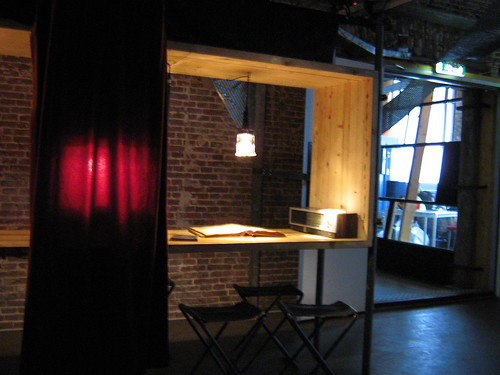
To the right you see Audrey Samson's graduation project, 'spectres'? as it was installed at Worm, 7/7/07.
He goes on to say that "I want to contribute as much as we can...making it [new technology] into a social context, interesting, being an ambassador, making it[computers] into a normal field."
Hopefully in a few years the students can contribute something back to the field. This is a long term investment for Hajo because he believes you have to be a little older to be radical. At first this sounds counter-intuitive because young people are often assumed to be radical by nature, but I think he's right. It takes experience to know where the boundaries are and what would be a real innovation.
At this point in the interview, Marco, who does all the accounting, walked by and commented jokingly that the people at Worm are technocratic conservatives, but with love. Hajo laughed and agreed; they try to leave good things in place and alter the bad things. They don't follow trends just for the sake of them, so they are multidisciplinary not as a goal, but as a practice. Their experiments have taught them that a party can be a medium; so can a meeting. So they will use whatever media best let them explore a possibility and bring it to people--in this way they are "radically pragmatic." This holistic approach means that rather than regarding meetings as a necessary evil or parties as merely celebration after the fact, both are an integral of the discovery process.
This sounds like a productive way of working, but also perhaps more challenging. I asked Hajo what the biggest challenge was, especially when collaborating with another institution. After some thought, he replied that "dealing with really talented people means making a structure in which they can operate." In this instance of collaboration with Piet Zwart, some of the people working at Worm stayed up all night once or twice to help students who (proving that there at least some universals) needed to do a lot of work at the last minute. Hajo asked them how they felt about that, if it had been fun to work in that intensive way and apparently it had been.
Here Florian talks a member of Worm in the the Wormshop about possibilities for future collaboration. I was impressed by how open everything was; they all just did their business as usual, even though I was just hanging around snapping pictures, a stranger to everyone except Florian.
Worm is not a rich organization; they started as an artists' squat and now depend mainly on grants from foundations and the government to support more ambitious projects, so they have to think about their spending priorities. This is another way they work on providing a structure--"so the office is crap, but the performances are good. Eventually they will get fed up with the office and fix it." Again, it depends on what the people working at and with Worm most need.
The group has worked in several locations before moving to their current space in an historic building in Delfshaven that presented quite a challenge. Because it is protected as a historic monument, Worm could not make any structural changes except those required by fire codes, so they took a novel approach to constructing their space. Working with architects who followed the principle of "superuse," they constructed a new interior structure entirely from salvaged material, and all either free-standing or attached only to a metal frame made with clamps braced between the walls, floors and ceilings. This frame is held in place only by pressure, it is not fastened to the building's structure. (For more on the construction, read about it in the Superuse book, or visit the 2012 Architects' Worm set on Flickr.)
Hajo likes the space but is not especially attached to it and had thought that it would be fine if they had to move when the city finally decided what to do with the building. But, he discovered during the weekend of the graduation show that some of his colleagues had come to really care about the building, and didn't want to juts give it up. So now Hajo is working on a proposal to buy the building, because he wants the people he works with to stay and be happy, and to do that, they need to have a more permanent home.
Given his other beliefs, it's not surprising that Hajo prefers a DIY approach, but he also has pragmatic reasons as well. Superuse is not only environmentally sound, but is significantly cheaper, just as switching to Linux allowed Worm to operate with a collection of salvaged computers without having compatibility issues. But this also allows them to be "masters of new technology rather than slaves."
At the same time, Worm no longer works outside the system. When talking about the difficulty more radical groups have with a transition to working with the system as they become more established, Hajo exclaimed "don't complain about the system if you aren't taking part in the system." Worm maintains a balance between a DIY approach and being a regular institution. "If freedom is 0-->100, we are 85, and this is a success. That freedom allows them to present acts, artists, films, or speakers that might only attract a few people, and count them as successes if they are interesting, rather than measuring success only by numbers in the audience or money in the till. Measuring success also takes time; Worm started the practice of "Live Cinema" which is occurs in venues all over the world. In that way it was a great success, but no one remembers that it started at Worm. But in Hajo's words, "if you really do something, you make a difference and that makes it fun."
Monday, July 16, 2007
Makedo project 1
Another cool project from the Piet Zwart students, this time from the first year show. This phone has on the first eight options statements from each artist in the first-year show, and then on the ninth, a chance for visitors to leave a message commenting.
It's a really cool interface I think! Far better than the usual leaflets or little white cards--though you can see one of those in the picture as well...Created by Annemieke van der Hoek. Now I have to leave this cafe and get the stuff we need for dinner.
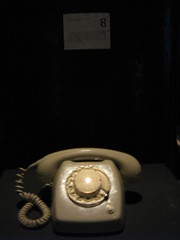
It's a really cool interface I think! Far better than the usual leaflets or little white cards--though you can see one of those in the picture as well...Created by Annemieke van der Hoek. Now I have to leave this cafe and get the stuff we need for dinner.
Monday, July 9, 2007
The heart of the Worm
Having caught up everything about the graduation show, now I'll get to the meeting I had this morning, with Hajo Doorn, director of Worm. I'll start by saying that of all the meetings and conversations I've had about how different institutions work here in the Netherlands, this was by far the best. In addition to offering me a wealth of information, Hajo let me really see inside Worm, as if I wasn't some random person dropping by, but somehow part of things. I'll explain that a little better later, but let me go in order.
Worm really is unique--of course every place wants to think that, but usually it's not true. In this case though, I can't think of any other cultural or arts organization I've ever seen that runs exactly like Worm. First of all, the range of activities is amazingly broad. Events held there include dance parties, film screenings, live bands, sound art installations, electronic/computer art installations, lectures, and educational activities like the recent Piet Zwart graduation. Worm also stands out because of the way they balance their growing role in the community, which gives them more chance at funding and at shaping the local conversation about art and culture in Rotterdam, with still maintaining the freedom of an outsider to take risks and to do things a little differently. That last is no small feat when dealing with civil servants and funding agencies. Finally, Worm is focused on people, inside the organization and those they collaborate with or invite in, rather than on their own institutional status.
This last characteristic was what Hajo most emphasized. But before I expand that point let me back up a bit and first say something about Hajos' take on the whole scene. The Netherlands is a small country, so it's not so hard for a group to get started and get some attention. They all compete with each other, which Hajo thinks is productive because it draws more attention to the scene as a whole. But, established institutions try to claim the discourse, which shuts out groups; this means they have to work hard to find a niche and show how they are different. Taking V2 as a contrast for example, according to Hajo, "V2 is big in their scene, but it's very small scene." He also commented on how they were not very connected to the local community, or to the open source community. I had noticed the latter when talking to Alex and everyone seems to recognized the V2 is very narrowly focused, the only question is whether they think the narrow focus is a deliberate strategy, or something that dooms V2 to shrinking relevance. Other organizations also seem far more hierarchical; both V2 and de Waag have a clear and seemingly rigid hierarchy with the people on top exerting very firm control over everyone else and having set guidelines for how they do everything. I'd say de Waag is not as rigid as V2, and maybe they need more structure since they have so many community stakeholders.
But Hajo and the others at Worm take it as a principle that they "design for people, not for systems," which means they have often asked their funding organizations or the civil servants they work with if they really want this kind of report or that kind of procedure, because it will cost so many thousands of Euros to produce. Often, the answer is no, and they find a different way to provide what the funding agency or civil servants need. In fact, while the other organizations I visited explained their goals and criteria, which were all about art, culture, and sometimes the community, I didn't get as clear a statement from them on their operating principles. Worm has several worth listing here:
- Energy is the most important quality [of a work or project]
- It's all about people
- Let's not pollute
- Design for people, not for systems
- Challenge the system
- Try to pay people, even a little
In fact, Hajo wasn't too concerned about this. He thinks that art should be local, and also he's really into a do-it-yourself (DIY) approach, which doesn't require huge chunks of money and isn't really consistent with international ambitions. Because he's always trying to do a lot with a little, Worm uses Linux running on computers that were salvaged, and Worms physical space is made with 80% recycled materials, mostly industrial salvage from the port (of Rotterdam). Along with the Polder model, the Rotterdam context is also very "flat" compared to other cities in the Netherlands, meaning that it's pretty easy to get access to officials, which helps groups to get started.
Hajo shared a lot of other information--it was a three-hour meeting, including coffee and the chance to listen in as he talked over the success of the Piet Zwart graduation show with Florian (who was there with students making official documentation) and as he talked about possible future collaborations, plans for the building, how to spend out the remaining budget--I've never seen another group be so casual, except maybe my own department--maybe that's why it was so comfortable. Anyway, I'll post more tomorrow because it's getting late!
Other interesting graduation projects
There were other good projects too; I posted the too that most captured my attention, which had to do not only with the project itself, but how much the student was right there as part of it, demonstrating or performing. Also, I don't have good pictures of the others because of how the space was lit and (more often) the way people were milling around and (most often) my open lack of experience trying to take photographs in conditions with high contrast lighting...
But, Piet Zwart is making extensive documentation that I believe they put into both Flickr and Youtube, so I will point to that when it's posted.
So, after seeing all this and staying really late, I just spent most of Sunday resting and taking the Spido tour, but today it was back to my research. This morning I went back over to Worm for another interview.
Andre Fiore's Cookie Census
This was another cool project, the Cookie Census. It lets you go to a website and identify what cookies are there and who placed them, and it will also show you the javascripts and little tracking bugs in the page. Right now it's not so robust, but once Andrea get's it working just a little more reliably, I think will be a great tool for data-mining. He says he will make it into a Firefox plugin, and I hope he does soon because I would love to see what is going on at the sites I most often visit.
I guess I should have taken my beer out of the picture; oh well...That makes it so much more authentic as being taken at a real event, where I sat with this project long enough to drink a beer while I talked to Andrea about it.
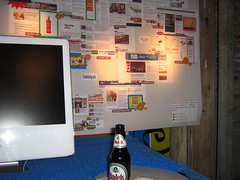
I guess I should have taken my beer out of the picture; oh well...That makes it so much more authentic as being taken at a real event, where I sat with this project long enough to drink a beer while I talked to Andrea about it.
Appreciative crowd watches Nancy perform "Paraphernalia"
And here you see some reaction to Nancy; this is before we all started singing along with her karaoke of A-ha and Tiffany songs...
The point though is that people were really interested. And those who know them will recognize who is watching, but I guess I will leave them anonymous since this is a candid picture, shot without asking.
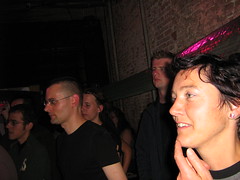
The point though is that people were really interested. And those who know them will recognize who is watching, but I guess I will leave them anonymous since this is a candid picture, shot without asking.
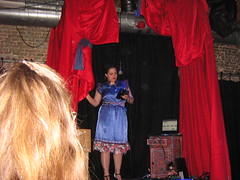
Nancy Mauro-Flude presents Paraphernalia
OK, this is Nancy's performance which I mentioned already. I can imagine a lot of bands or performers that would really like to have something that is not only wireless, but responds to gestures, to position, rather than being just some keypad. And Nancy has personalized the interface for herself, but that also could change, which I think might be even more interesting to performers, to use a tool that really matches their style. Also, Nancy made these tools herself with (I think) just a little help with programming, which means that other musicians and performers could make their own tools as well, without needing an a degree in software or electrical engineering, which to me seems a very liberating development.
Sunday, July 8, 2007
Voorhaven, clouded over
Even on cloudy days, it looks dramatic. Of course this stretch is essentially the historical street left in the city, so any post card that shows and old building is almost certain to have been shot on this street!
A lovely place to walk, and has several cafes, antique stores, and the industrial scrap shop from which the students got a lot of stuff for the show.
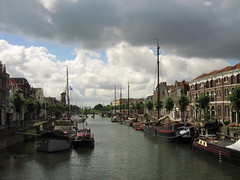
A lovely place to walk, and has several cafes, antique stores, and the industrial scrap shop from which the students got a lot of stuff for the show.
Worm bar
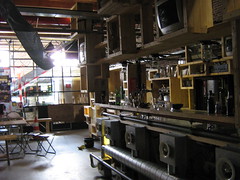
Here is the bar inside Worm; the whole thing is constructed inside a historical building, the structure which couldn't be touched. So, everything is attached to a free standing metal framework and is all made of industrial scrap from the harbor. It's amazing. About 4-5 projects were set up in this room later in the day, and they fit in really well.
Ok, back from dinner and more on the party at Worm. I have to say it was a blast, not least because I haven't had the chance to go out dancing like that in years. First one of th Piet Zwart graduates did a performance, which was really cool. --Nancy Mauro-Flude did a final project:
'Paraphernalia' consists of self-built controllers for audio/dance performances that free performers from operating laptops on stage, giving them back their gestural mobility, and allowing both a technical and artistic feedback between music, vocals, dance and technology. (Realized with joystick interfaces, analog motion sensors and modified gamepads in conjunction with the real-time signal processing software Pure Data.)She did a performance singing with these tools and it was a lot of fun. After that, there was a DJ for awhile and people danced hard, including both the PZI MD staff and the students--how many grad students celebrate with their faculty that way? I drank rather a lot of Budels Honig Bier, but not too much to be ok today.
I got to bed quite late, but got up in time to shop for souvenirs and take a Spido boat tour of the harbor--that was really cool and I will post some pictures from the whole weekend soon. I think tomorrow I might finally have time to catch up on more conference reporting...
After a busy few days, here I am again. The conference in Utrecht was mixed; I saw several interesting key note speakers, including Katherine Hayles and Joanna Zylinska, and I met some very nice, interesting people, including Renee Turner, an artist from Geuzen.org, Yasco Horsman, from the University of Leiden, and Manuela Rossini from the University of Amsterdam. I think though that at both this conference and at New Network Theory, many of the panels would have been better as roundtable discussions.
Let's see, I'll comment on the best of the talks tomorrow when I'm not so tired. I still feel pretty washed out because I spent most of yesterday (and last night) at the Piet Zwart Media Design graduation, final show, and opening/graduation party. That was all at Worm, a music/art/cultural space here in Delfshaven. I'm interviewing the director, Hajo Doorn tomorrow, about the Worm is organized. The graduation was really great. Worm is a great space for the students to install their projects, and the projects themselves were quite interesting. Kristina, one of the tutors, made a speech full of advice, and then Florian spoke, starting with the hope that they didn't regret working with him, since he took over as Course Director half way through their program and had been a hard-ass. It was a startlingly candid statement for a graduation speech! The nicest thing though was how personal the whole event was. There were only nine students graduating so each was individually addressed--maybe it was too personal for some of the students who seemed really embarrassed when Florian made (positive) comments about each of their work and personalities. Then we had some lunch, and then Florian gave another general speech opening the show, and then we all hung around for a few more hours. I talked to several students about their projects; one of my favorites was by Andrea Fiore, called Cookie Census. This project is:
A software platform for the collaborative tracking and annotation of web cookies. Considering them identifiers and actuators of user control, the Cookie Census provides a distributed system for their survey and annotation. (Realized as a combination of a web browser plugin, MySQL database and web site.)Finally around 7 or 8 I went to dinner with Florian, Josephine Bosma, and her daughter Jasmin. Because the good place we wanted to go was too crowded, we instead had some Roti, which was also good, but my duck had a ridiculous number of little broken bones in it. Anyway, Josephine is an interesting person; I've enjoyed reading her articles about digital media, and the art/theory scene in Europe and was happy to meet her in person. Jasmin is also really cool--I hope my girls are as much so when they reach her age.
So, we went back to Worm and the party opened at 9pm. I looked at more projects and had a chance to talk again at length with Mirko Schaefer whom I had seen and briefly met at the Network theory conference. he's a really nice guy who does a lot of research about open source communities, and is finishing up his dissertation at Utrecht University where he's a lecturer. Now I'm going to dinner, so I'll write more later. --and damn, the blockquote has messed up my spacing.
Subscribe to:
Posts (Atom)


